
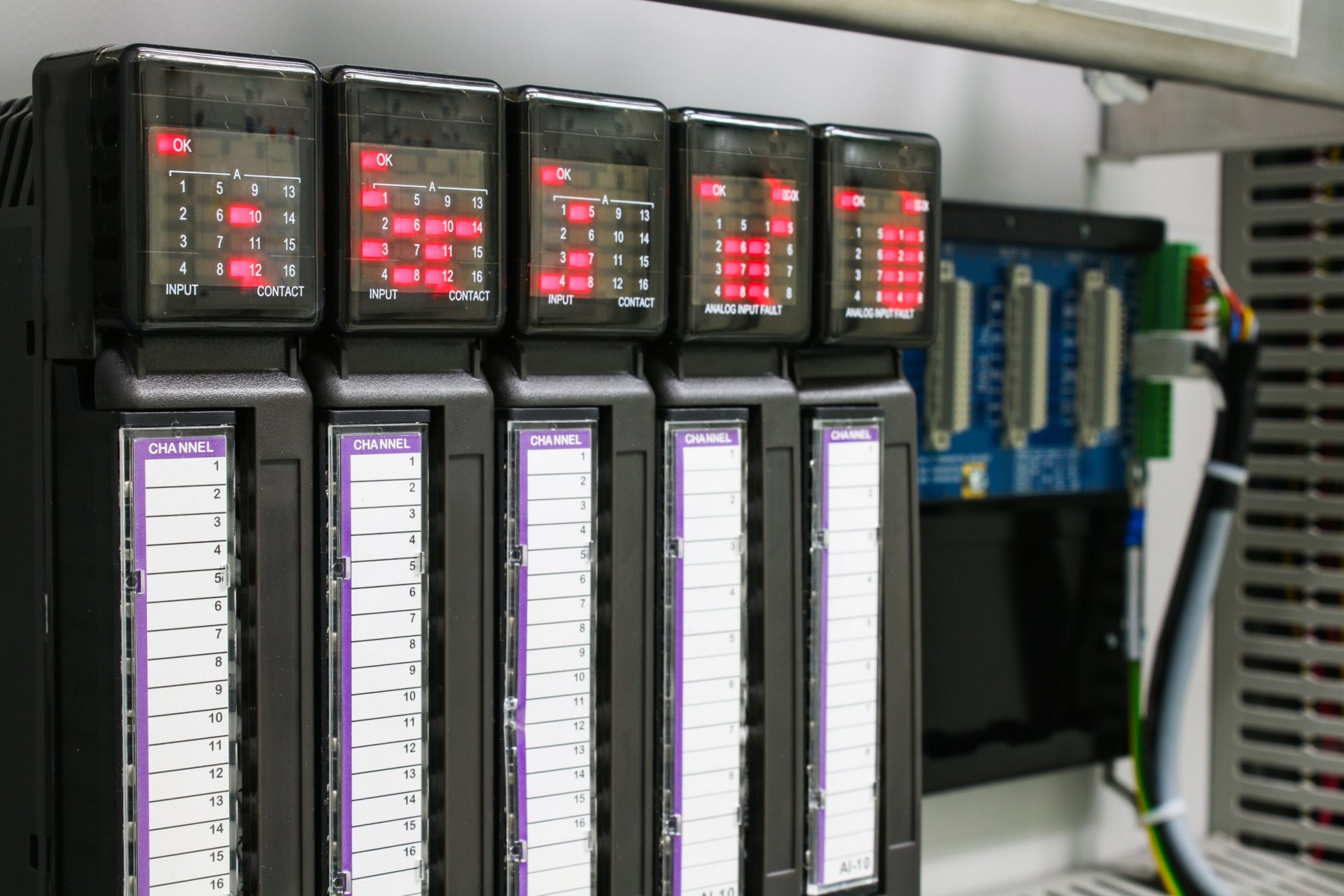
A PLC rack is the backbone of a programmable logic controller system. This is because it provides the physical framework that organizes and connects modules for industrial automation, whether managing a large-scale manufacturing system or not, understanding how PLC racks function helps in ensuring reliable and scalable control.
This article explores what a PLC rack is, its key components, available types, benefits, and common troubleshooting steps.
What Is a PLC Rack?
A PLC rack is a modular mounting structure that houses and connects the essential components of a programmable logic controller (PLC) system. Moreover, it provides sturdy mechanical support and reliable electrical connections for the CPU, I/O units, communication interfaces, and power supplies. These modules plug into slots along a shared backplane, which distributes power, thus enabling smooth data exchange.
The rack design ensures efficient operation by synchronizing power and communication signals, allowing easy expansion or replacement of modules. PLC racks serve in applications ranging from small machinery to large-scale industrial processes, including manufacturing, energy, and utilities.
Key Components of a PLC Rack
Backplane
The backplane is a high-density printed circuit board (PCB) that forms the electrical backbone of the PLC rack. Also, it provides the electrical pathways that enable data and power communication between all installed modules. The backplane’s bus design allows multiple modules to send and receive data simultaneously. This reduces delays and ensures control signals happen exactly when needed. Such precise timing is crucial for real-time automation systems to respond quickly and reliably.
CPU Module
The CPU module functions as the central processing unit of the PLC system. It executes ladder logic or structured text programs stored in non-volatile memory. Equipped with a microprocessor or microcontroller, the CPU manages task scheduling, I/O scanning, communication protocols, as well as diagnostics. Advanced CPUs feature integrated real-time clocks, high-speed counters, and motion control capabilities to meet complex automation demands.
I/O Modules
I/O modules connect the PLC to external devices by handling inputs from sensors and sending outputs to actuators. In addition, they provide electrical isolation and signal conditioning, ensuring reliable communication between the PLC and field devices.
- Input Modules: Convert signals from sensors into data that the CPU can process. Digital inputs handle on/off signals, while analog inputs process variable signals like temperature or pressure.
- Output Modules: Send control signals to devices. Digital outputs switch devices on or off, whereas analog outputs provide variable control for devices like drives or valves.
Some modules offer advanced features such as fast response, fault detection, or local control to improve system performance.

Power Supply
The power supply converts incoming AC voltage into the low-voltage DC power needed by the CPU, I/O modules, and other components. Most PLC systems use 24V DC for safety and compatibility with industrial devices. A reliable power supply ensures stable voltage and current, therefore protecting the system from fluctuations, spikes, and overloads. It often includes built-in fuses, overvoltage protection, and thermal shutdown features to maintain consistent operation. In larger systems, the power supply usually powers only the PLC modules, while field devices have separate power sources. In smaller or micro-PLC setups, the power supply may also serve field devices.
Communication Modules on a PLC Rack
Communication modules enable seamless data exchange between the PLC system and external devices or networks. Key features include:
- Acting as gateways connecting PLCs to other PLCs, SCADA systems, HMIs, and industrial networks.
- Supporting multiple industrial communication protocols such as Ethernet/IP, Modbus, Profibus, DeviceNet, and Profinet.
- Facilitating real-time data transfer, remote monitoring, and control across complex automation systems.
- Providing multiple ports and hardware interfaces, including RJ45 connectors and fiber optics, resulting in reliable, high-speed communication.
- Enabling seamless integration of the PLC into broader control architectures, thus improving scalability and interoperability.
- Supporting advanced functions like network diagnostics and redundancy to boost system reliability.
PLC Rack Enclosure
The rack enclosure provides mechanical support and protects the internal components from environmental factors. Constructed from rugged materials, such as powder-coated steel or aluminum, it offers EMI shielding and safeguards against dust, moisture, and vibration. Proper thermal management within the enclosure, including ventilation or cooling fans, maintains optimal operating temperatures to prevent component failure.
Types of PLC Racks
PLC racks come in different configurations to suit various industrial automation needs.
Fixed (Integrated) Racks
Fixed racks have all PLC modules built into a single, compact enclosure. This design is ideal for small-scale applications with limited or no need for future expansion. Because the modules are integrated, installation is straightforward, but flexibility is limited.
Modular Racks
Modular racks allow individual modules to be added, removed, or replaced easily. This flexibility supports system scalability, thus making modular racks suitable for applications that may grow or require customization over time.
Remote Racks
Remote racks are installed separately from the main PLC system and connected via communication links such as Ethernet or fieldbus networks. This setup is ideal for large plants with distributed control requirements, enabling localized control and reducing wiring complexity.
Chassis-Mounted Racks
Chassis-mounted racks are designed to be installed directly within control cabinets or panels. This mounting style saves space and protects the PLC components within a controlled environment. It is commonly used in industrial settings where compact and organized control systems are essential.
Benefits of Using PLC Racks
- Modularity: PLC racks allow easy expansion and reconfiguration by simply adding or removing individual modules. This modular design enables quick adaptation to changing automation requirements without overhauling the entire system.
- Improved Organization: By housing all components in one rack, the system stays organized. As a result, maintenance and troubleshooting are faster and less error-prone.
- Reduced Downtime: When a module fails, it can be replaced independently without shutting down the entire PLC system. This minimizes production interruptions and enhances overall operational efficiency.
- Scalability: PLC racks support future growth by accommodating additional modules, thus ensuring the system can evolve with increasing automation demands.
- Reliable Performance: The rack’s design ensures stable electrical connections and reduces signal interference between modules. This reliability is crucial for maintaining accurate and consistent control in industrial environments.
- Compliance: Designed to meet industry safety and communication standards, PLC racks guarantee secure and standardized operation.
Common PLC Rack Issues and Troubleshooting Tips
| Issue | Possible Cause | Troubleshooting Step |
| The system fails to start | Power supply failure or CPU malfunction. | Check the voltage at the power supply terminals to ensure proper input. Next, inspect CPU status LEDs for error indicators or fault codes. Then replace the power supply or the CPU if necessary. |
| Module not responding | Loose connection or defective module. | Power down the system, then reseat the module firmly in its slot. If the problem persists, replace the module with a known good one. |
| Communication errors | A faulty communication module or a damaged cable. | Test communication cables for continuity and proper connection. Reconnect or replace cables and communication modules as needed. Verify correct protocol settings. |
| I/O is not functioning properly | I/O module failure or wiring faults. | Check wiring connections for loose or broken wires. Use a multimeter to verify input and output signals. Replace faulty I/O modules if necessary. |
| Overheating | Insufficient ventilation or excessive load. | Ensure the rack enclosure has adequate cooling, such as fans or vents. Verify modules are not overloaded beyond their rated capacity. Maintain proper spacing between modules. |
| Error codes on the CPU module | Programming logic errors or configuration issues. | Consult the PLC’s user manual to interpret error codes. Review and correct the program logic or configuration settings. Perform a system reset if required. |
Tips for PLC Rack Maintenance and Installation
- Keep PLC racks clean and free of dust to prevent overheating and electrical faults.
- Install racks in temperature-controlled environments to maintain optimal operating conditions and extend component life.
- Clearly label all modules and wiring to simplify identification during maintenance and troubleshooting.
- Use surge protectors to safeguard the system from voltage spikes and electrical surges.
- Regularly back up CPU programs and configurations to prevent data loss and enable quick recovery after failures.
Following these practices helps ensure the reliable performance and longevity of PLC systems in industrial settings.
Reliable PLC Rack Solutions for Smarter Automation
PLC racks play a vital role in organizing control components, ensuring efficient power distribution, seamless data communication, and enabling system scalability. Proper rack selection and integration are key to building reliable and flexible automation systems. At Panelmatic, we support a wide range of industrial automation needs by providing expertly designed PLC rack solutions tailored to enhance performance and durability. Contact us today to discover how we can help optimize your automation projects with dependable and scalable control solutions.