
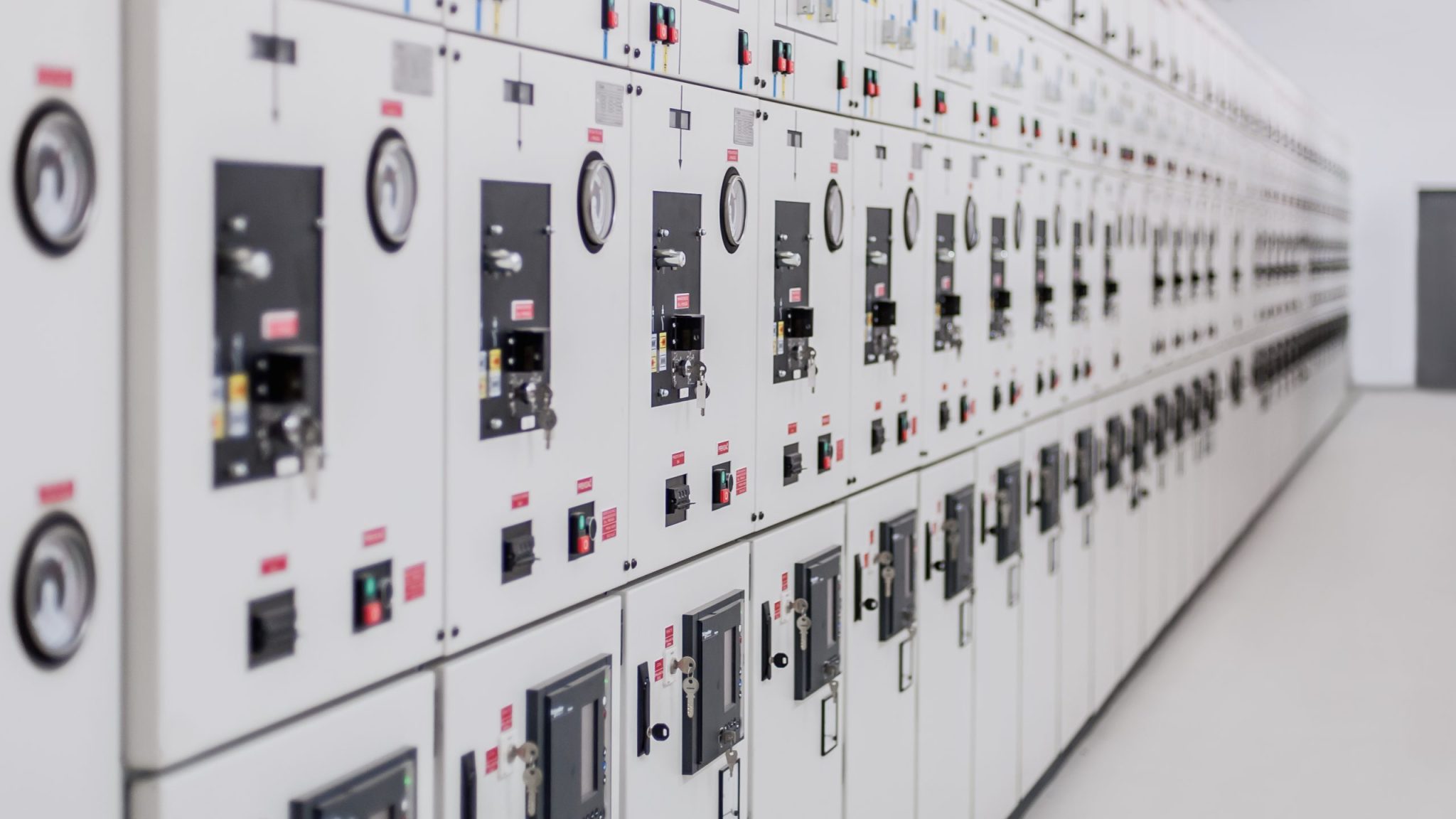
Switchboards and switchgear play crucial roles in electrical power distribution, but they serve different purposes and have distinct features. This article explores what switchgear and switchboards are, the key differences in the debate on switchgear vs switchboard, as well as FAQs.
What is a Switchgear
Switchgear is a comprehensive electrical assembly enclosed completely on all sides excluding ventilation openings as well as inspection windows. It houses primary power circuit switching or interrupting devices with buses and connections. The design of switchgear is flexible, catering for voltages of up to 38 kV and also currents up to 6,000A. Moreover, switchgear design is as per standards such as ANSI C37.20.1, NEMA SG-5, and UL 1558, to ensure safety via compartmentalization. Unlike panelboards that just distribute power to end-use loads, switchgear controls and protects primary circuits.
Components of a Switchgear
Power Switching Devices
These components are responsible for interrupting electrical currents during normal operation or fault conditions.
- Circuit Breakers: Automatically trip to stop current flow during overloads or short circuits. Common types include air, vacuum, and SF6 circuit breakers. Air circuit breakers (ACBs) can serve in low-voltage applications up to 1000V. Vacuum circuit breakers utilize vacuum interrupters for medium voltage systems between 1kV and 38kV. Whereas, SF6 circuit breakers employ sulfur hexafluoride gas for superior arc quenching in high-voltage applications.
- Fuses: Sacrificial devices that melt under excessive current, hence, breaking the circuit. These are crucial for overcurrent protection.
- Disconnect switches: They enable manual isolation of circuits during maintenance operations. These devices operate under no-load conditions and also provide visible confirmation of circuit isolation.
Control Components
These devices monitor, regulate, and protect the electrical system.
- Protective Relays: These are intelligent devices capable of detecting abnormal conditions in an electrical system, such as overcurrent, under-voltage, or phase imbalances. On detecting a fault, the relay signals the circuit breakers to trip, hence, isolating the affected section to prevent damage.
- Meters and Sensors: Monitor system performance by measuring parameters such as voltage, current, frequency, and power quality. These devices provide real-time data for operational oversight as well as fault analysis.
- Control Transformers: Step down high voltages from the main circuit to lower levels suitable for operating control devices like relays and meters.
- Control Panels: Key functions include circuit control, protection coordination, as well as system monitoring through integrated wiring systems.
Enclosure & Safety Features
Switchgear enclosures ensure operator safety and system reliability.
- Metal Partitions: Separate high-voltage components to prevent arc flash propagation. These barriers must withstand internal arc faults per IEEE C37.20.7 standards.
- Insulated Busbars: Utilize heat-shrink-sleeving or epoxy coating to reduce electrical clearance requirements.
- Grounding Systems: Provide a safe path for fault currents to prevent electric shock.
- Arc-Resistant Design: Reinforced enclosures redirect blast energy away from personnel.
Draw-Out Mechanisms
Draw-out technology employs rail systems to disconnect and remove circuit breakers without disrupting the overall operation of the electrical system.
- Rackable Breakers: Utilize threaded shafts or motorized drives to transition between different operational positions, such as connected, test, and disconnected. Threaded shafts allow precise manual control, while motorized drives enable automated racking for efficiency and convenience.
- Test & Disconnect Positions: In the test position, control circuits stay engaged while power circuits are isolated. This allows diagnostic testing without energizing the main system. In the disconnected position, both control and power circuits are fully disengaged, ensuring complete isolation for maintenance or replacement.
- Interlocks: These are safety mechanisms integrated into draw-out systems to prevent hazardous operations. For example, interlocks ensure that a circuit breaker cannot be removed while it is energized or in a connected position. They also prevent accidental movement between operational states without proper authorization or procedures.
Types of Switchgear
The classification of switchgear can be based on voltage level, insulation type, and construction design.
Voltage Level
- Low-Voltage (LV) Switchgear: Suitable for systems operating at voltages up to 1 kV. These are common in residential, commercial, and light industrial applications for controlling and protecting low-voltage circuits.
- Medium-Voltage (MV) Switchgear: Operates with voltage ratings between 1 kV and 35 kV. MV switchgear is ideal for industrial plants, utilities, and large buildings, offering protection and also control for medium-scale electrical distribution.
- High-Voltage (HV) Switchgear: Necessary for systems operating at voltages above 35 kV. They are common in power transmission and large substations to manage high-voltage electrical grids and also prevent faults.
Insulation Type
- Air-Insulated Switchgear (AIS): Uses air as the primary insulating medium. This makes it a cost-effective solution in low and medium-voltage applications. However, it is limited by space constraints and requires larger dimensions for insulation.
- Gas-Insulated Switchgear (GIS): GIS uses sulfur hexafluoride (SF6) gas as the insulating medium, allowing for a more compact design.
- Oil-Insulated Switchgear (OIS): Utilizes oil for insulation and cooling; typically present in older systems. These are common in high-voltage applications, although their use is minimal due to environmental concerns.
Based on Construction
- Metal-Clad Switchgear: This type of switchgear features components housed in separate metal compartments, hence, providing a higher level of protection. The compartments are capable of preventing the spread of faults, ensuring greater safety for personnel and also the system.
- Metal-Enclosed Switchgear: In metal-enclosed switchgear, components are contained within a single metal enclosure. This design offers enhanced protection against external elements and reduces the risk of accidental contact with live parts.
- Pad-Mounted Switchgear: Designed for outdoor installations, pad-mounted switchgear is typically used in utilities or distribution networks. It is mounted on a concrete pad, providing easy access for maintenance while being protected from environmental factors.
What is a Switchboard
A switchboard is a centralized panel that distributes electrical power to downstream circuits while providing protection and control. It houses circuit breakers, busbars, and meters in a non-compartmentalized enclosure. Their construction generally follows standards such as UL 891 and NEMA PB-2.
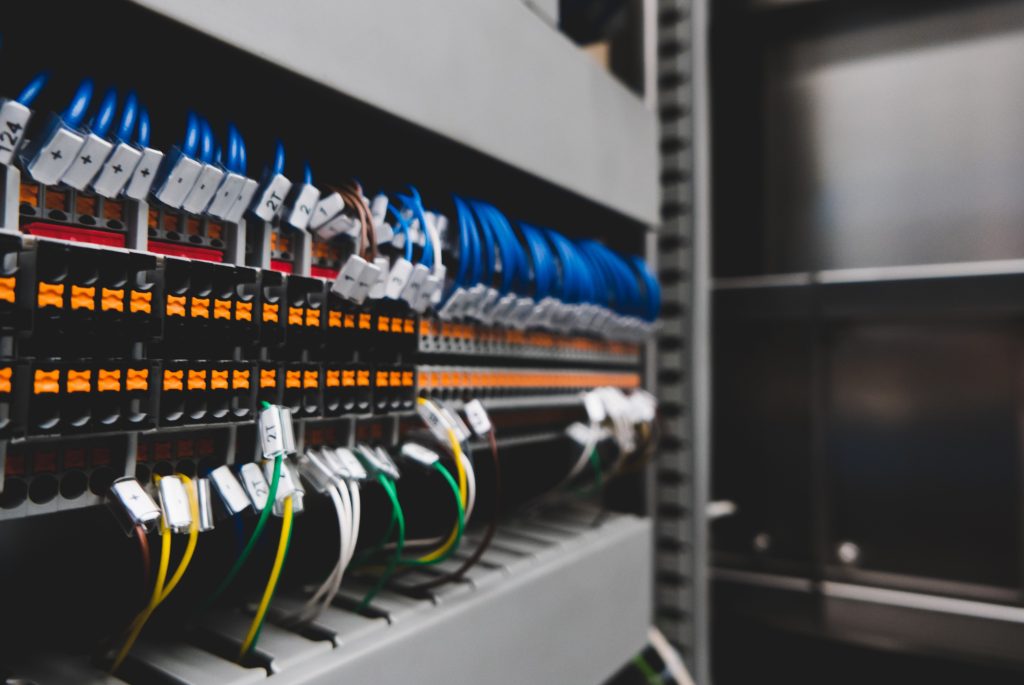
Components of a Switchboard
Power Distribution Components
- Main Circuit Breaker: Serves as the primary disconnect and overcurrent protection device for the entire switchboard. It isolates the entire system during faults or maintenance and prevents damage due to overloads or short circuits.
- Branch Circuit Breakers: Protect individual circuits such as lighting systems, HVAC units, or machinery from overloads and short circuits. These breakers allow selective isolation of specific circuits without affecting the entire system, ensuring operational continuity.
- Busbars: Conductive bars made of copper or aluminum that distribute power from the main circuit breaker to branch circuits within the switchboard. Busbars are designed for high current-carrying capacity and low resistance to minimize energy losses during power distribution.
Control & Monitoring Devices
- Voltage/Current Meters: Provide real-time measurements of electrical parameters such as voltage, current, power factor, and frequency. These meters are critical for monitoring system health, identifying inefficiencies, as well as detecting abnormalities in power flow.
- Control Relays: Automate operations such as transferring loads to backup generators during outages or activating alarms during faults.
- Indicator Lights: Visual indicators that display circuit status (on/off/fault), allowing operators to quickly assess system conditions at a glance.
Structural & Safety Features
- Dead Front Panel: Covers live parts to prevent accidental contact with energized components.
- Enclosure: NEMA-rated steel housing protects against dust, moisture, and physical damage.
- Grounding System: Ensures fault currents safely dissipate into the earth through a dedicated grounding conductor or electrode system. Grounding reduces risks of electric shock and equipment damage.
Types of Switchboards
- General Purpose Switchboards: These switchboards consist of surge protection, fused switches, molded case circuit breakers, and insulated case circuit breakers. General-purpose switchboards typically feature a front-accessible design with group-mounted components.
- Commercial Metering Switchboards: This type of switchboards include provisions for utility metering equipment.
- Fusible Switchboards: These switchboards utilize fuses as the main overcurrent protective device instead of circuit breakers.
- Draw-out Molded Case Switchboards: These switchboards feature molded case circuit breakers that can be removed without de-energizing the entire assembly.
Differences between Switchgear vs Switchboard
| Criteria | Switchgear | Switchboard |
| Voltage | Suitable for low, medium, and high-voltage applications, covering a range from 1 kV to 350 kV AC. | Generally serves in systems of 600 V or less. |
| Current Rating | Handles higher current ratings, typically up to 6,000 A. | Designed for lower current ratings, typically up to 5,000 A. |
| Components | Includes circuit breakers (often draw-out), relays, fuses, isolators, and also lightning arresters. | Features fixed-mounted circuit breakers, busbars, as well as control devices for power distribution. |
| Standards | Complies with ANSI C37.20.1, UL 1558, and NEMA SG-5. | Meets UL 891 and NEMA PB-2 standards. |
| Maintenance | Allows isolated maintenance through draw-out circuit breakers. | Requires complete shutdown for most maintenance work. |
| Control System | Integrated control panels with advanced automation (SCADA-ready). | Basic control via standalone devices or external panels. |
| Construction | Larger and more robust with both front and rear access for cable terminations. | Compact design with front access. |
Frequently Asked Questions on Switchgear vs Switchboard
What is the main difference between switchgear and a switchboard?
The primary difference between a switchgear vs a switchboard lies in voltage handling and protection capabilities. Switchgear is ideal for medium to high voltage applications and provides advanced protection and fault isolation. Switchboards, on the other hand, can serve for low to medium voltage applications and focus on power distribution rather than protection.
How do Safety Features Compare Between a Switchgear vs Switchboard?
Switchgear offers superior safety features, including:
- Arc-resistant enclosures that contain as well as redirect arc flashes.
- Remote operation to minimize personnel exposure to high-voltage risks.
- Advanced fault detection and isolation mechanisms.
Switchboards, while safe, do not provide the same level of fault isolation and automation as switchgear.
How do I choose between switchgear vs switchboard for my facility?
Consider these factors:
- Voltage Requirements: If your system operates above 1 kV, switchgear is necessary.
- Protection Needs: When advanced protection and remote control are necessary, switchgear is better.
- Budget: If cost is a primary concern and voltage needs are lower, a switchboard is ideal.
- Space Constraints: If there are space limitations, switchboards take up less room.
Can switchgear and switchboards be used together?
Yes, they can work together within a power distribution system. Switchgear can manage high-voltage transmission, while switchboards handle localized, low-voltage distribution within a facility.
Which is more cost-effective: switchgear vs switchboard?
Switchboards are more cost-effective for standard low-voltage applications. Switchgear is more expensive but necessary for high-voltage protection and system reliability.
Choosing the Right Electrical Design with Panelmatic
Since 1957, Panelmatic has been leading the electrical manufacturing industry with our ever-increasing range of products and services. From innovative solutions to exceptional quality, our dedication to customer satisfaction and excellence drives everything we do. No matter what your electrical system needs are, Panelmatic has your back. Contact us today for more details and our team is ready to join you on your project.